Before buying lift kits and truck accessories in Reading, choose between a leveling system and a complete suspension lift. A leveling kit corrects factory rake while preserving daily manners, and a suspension lift adds clearance, wheel travel, and larger tire fitment. Collect precise year, trim, drivetrain, and suspension details to confirm Rough Country fit. Budget for tires, alignment, and accessories like steps, lights, or liners—you'll understand how the right setup comes together.
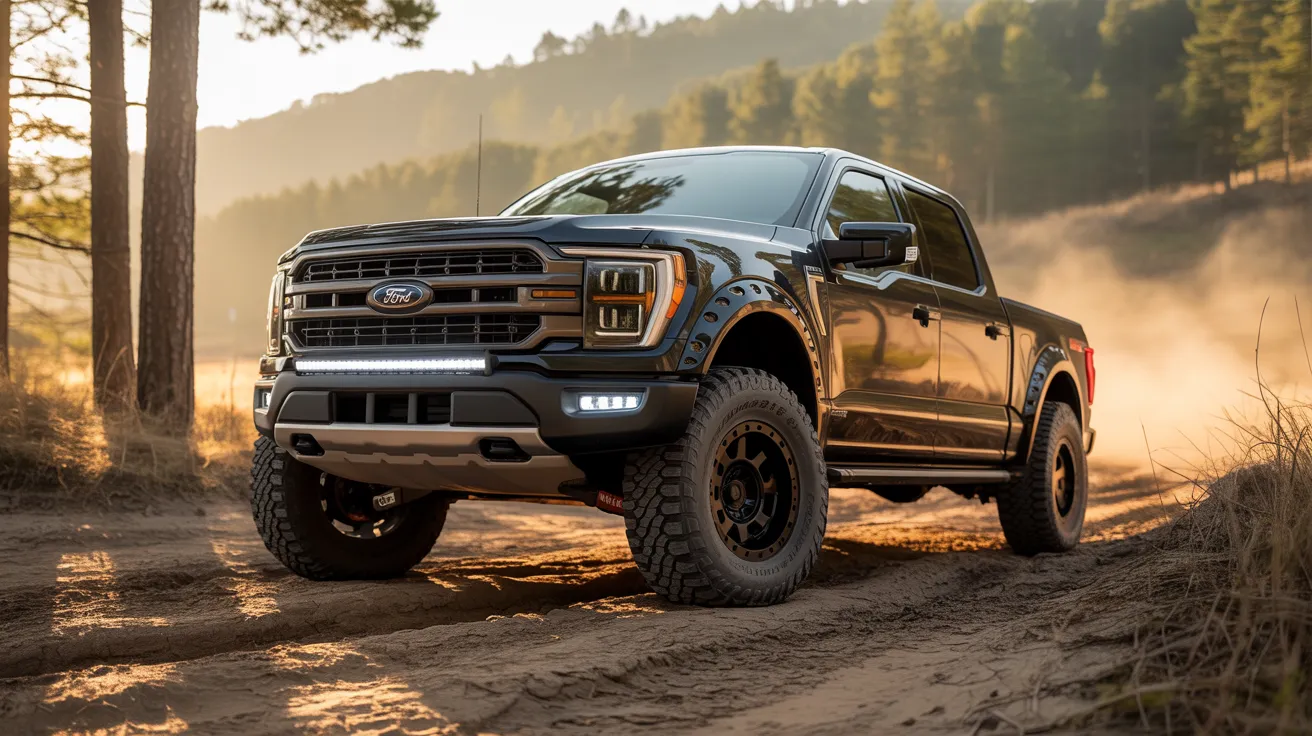
Main Points
- Select a leveling kit to remove factory rake while preserving near-stock performance and allowing slightly larger tires for daily driving.
- Choose a suspension lift for added ground clearance, wheel travel, and off-road performance, recognizing that handling and steering may differ.
- Confirm proper fitment by verifying your truck's year, model, make, drivetrain, trim, cab, bed, and suspension setup prior to ordering Rough Country products.
- Select lift height and shocks based on your use, such as commuting, mixed trail use, towing, or serious off-road travel.
- Budget for more than the kit price, including alignment, labor, wheels, tires, shocks, and supporting accessories like steps, lights, and liners.
Suspension Lift Kits Against Leveling Kits
Since both upgrades affect your truck's stance, suspension lift kits and leveling kits resolve different issues and offer different results. A leveling upgrade generally raises the front to match the rear, correcting factory rake with minimal change to geometry, ride height, and drivability. You use one if you desire a cleaner appearance and room for slightly larger tires.
A suspension lift kit raises the whole truck and modifies key components to produce more ground clearance and suspension travel. You'll notice larger improvements in ride height, off-road capability, and tire fitment, but you should anticipate handling tradeoffs, steering changes, and a higher center of gravity. If you want subtle visual improvement, level it. If you require real clearance and articulation, lift it and design the supporting mods around your needs.
Find the Rough Country lift kit that matches your truck.
Begin by identifying your truck's year, make, and model, transmission type, and primary application, because Rough Country manufactures lift kits for exact geometric requirements and performance goals. That information shows which mounting hardware and suspension elements can bolt on without clearance or alignment issues.
Start by reviewing OEM ride height, cab and bed configuration, axle type, and whether your truck has 2WD, 4WD, or adaptive suspension. Rough Country fitment resources make this easy, but you should check model compatibility against configuration-specific components and OEM package variations. A kit engineered for a Silverado 1500 might not work with a Trail Boss, and a Ram equipped with air-spring suspension demands different provisions rather than a vehicle with coil suspension. Once you verify fitment first, you sidestep install surprises, component conflicts, and return hassles.
What Rough Country lift kit suits your driving style?
Select the kit to your driving patterns, and you'll enjoy enhanced ride quality, durability, and additional tire clearance without purchasing unnecessary capability. If you mainly commute in your truck, select a simple Rough Country leveling kit or a suspension lift of 2 to 3.5 inches designed for commuting comfort and predictable steering behavior.
If your truck sees both pavement and trail time, step up to a suspension system featuring premium shocks and corrected control arm angles. You'll achieve improved trail handling, improved articulation, and capacity for bigger tires without overstressing factory components. For serious trail work, emphasize lifted struts, N3 or Vertex dampers, and setups that keep driveline angles correct under compression. The correct Rough Country kit must match payload, speed, and terrain, and how firm a ride you can accept.
Premium Rough Country Truck Accessories
Round out your lift setup with Rough Country add-ons that address the genuine problems you'll see once you lift it and add bigger tires. Focus on upgraded entry steps or rock sliders, which recover entry to the cabin and offer lower-body protection now that your truck sits higher and broader.
focus
What Budget Should You Plan for Your Build?
After selecting the lift kit and supporting accessories, allocate comprehensive article a budget beyond the base price. You'll need money for shock units, wheel sets, tire options, alignment work, labor, and any steering or drivetrain adjustments your platform requires. Brand reputation counts; quality kits typically deliver stricter specs, smoother rides, and easier installations.
For accurate cost estimates, expect budget-friendly spacer or leveling kits to start at the bottom, while full suspension systems with control arms, tuned dampers, and larger tires climb quickly. Installation complexity, shop rates, and calibration work can add significantly. You should also price additional upgrades such as gear modifications, brake parts, and recovery equipment if you're building for trail use. If budget is a concern, evaluate financing options thoroughly and prioritize dependability over showy accessories.
Common Questions Answered
Do Lift Kits Impact Factory Warranty?
Yes, suspension lifts can impact your factory warranty coverage, yet they won't automatically nullify it. You encounter warranty implications should a dealer proves the lift kit resulted in or played a role in a defect. Engine, steering, suspension, and drive system disputes often trigger dealer disagreements. You must maintain documentation of installation, use quality components, and follow service intervals. This allows you to dispute denied claims and protect coverage where the modification isn't responsible.
Does Going Bigger Require Gear Changes?
Yes—if you jump several tire sizes, you'll usually need gear ratio changes. For example, when you move from 31s to 35s, your vehicle can feel sluggish, hunt for gears, and build drivetrain stress under load. Re-gearing restores effective gear ratios, helping you recover power, towing capability, and shift quality. You might not need it for a small tire upgrade, but if acceleration, mileage, or shifting deteriorates, it's normally the right choice.
How Often Should Lift Kit Components Be Inspected?
You need to examine lift components after the first 500 miles, then each time you change oil or at 3,000 to 5,000 mile intervals, based on your usage. Periodic inspections enable you to catch wear on bushings, shock fluid leaks, damaged brackets, and alignment concerns ahead of time. Verify fastener tightness post-aggressive terrain driving, cargo hauling, or hard impacts. When you operate in muddy, salty, or challenging terrain regularly, shorten intervals and examine suspension and steering parts more frequently.
Can a lift kit change towing or payload capacity?
Yes, a suspension kit can affect your truck's towing and payload ratings. When you increase ground clearance for additional clearance, you change suspension geometry, center of gravity, and stress on parts. That can decrease stability under weight and boost drivetrain stress, especially with larger tires. You should follow your OEM specifications unless an engineered kit clearly outlines revised capacities. Correct alignment, gearing, and brake performance are important as well.
Should alignment checks occur following installation of truck modifications?
Yes—if products shift ride height, suspension angles, steering angles, or tire circumference, you require an alignment service. You'll sense the outcome fast: minor tweaks can pull your truck off-center, reduce tread life, and affect handling response. A thorough alignment restores camber, caster, and toe to standard specs. After certain installs, you should also consider brake adjustment for electronic driver aid accuracy. You protect tire life, steering precision, and practical safety by getting alignment checked immediately.
Final Thoughts
Picking the right suspension system and upgrades comes down to your vehicle's purpose, your aesthetic choice, and what your budget can handle. When you connect a Rough Country system alongside your driving preferences, you'll get performance, clearance, and looks that work together as smoothly as a fine-tuned transmission. Incorporate smart accessories, manage your expenses thoughtfully, and you'll construct a automobile that's practical on the road, competent outdoors, and ready for whatever job comes next.